

Sales Invoices
Manage your outbound tax and commercial invoices — the list, filters, and how to create a new document.
The Sales Invoices page lists the outbound invoices you issue to your customers — both tax invoices and commercial invoices — and is where you start a new one. Open it from Sales → Invoices in the sidebar.
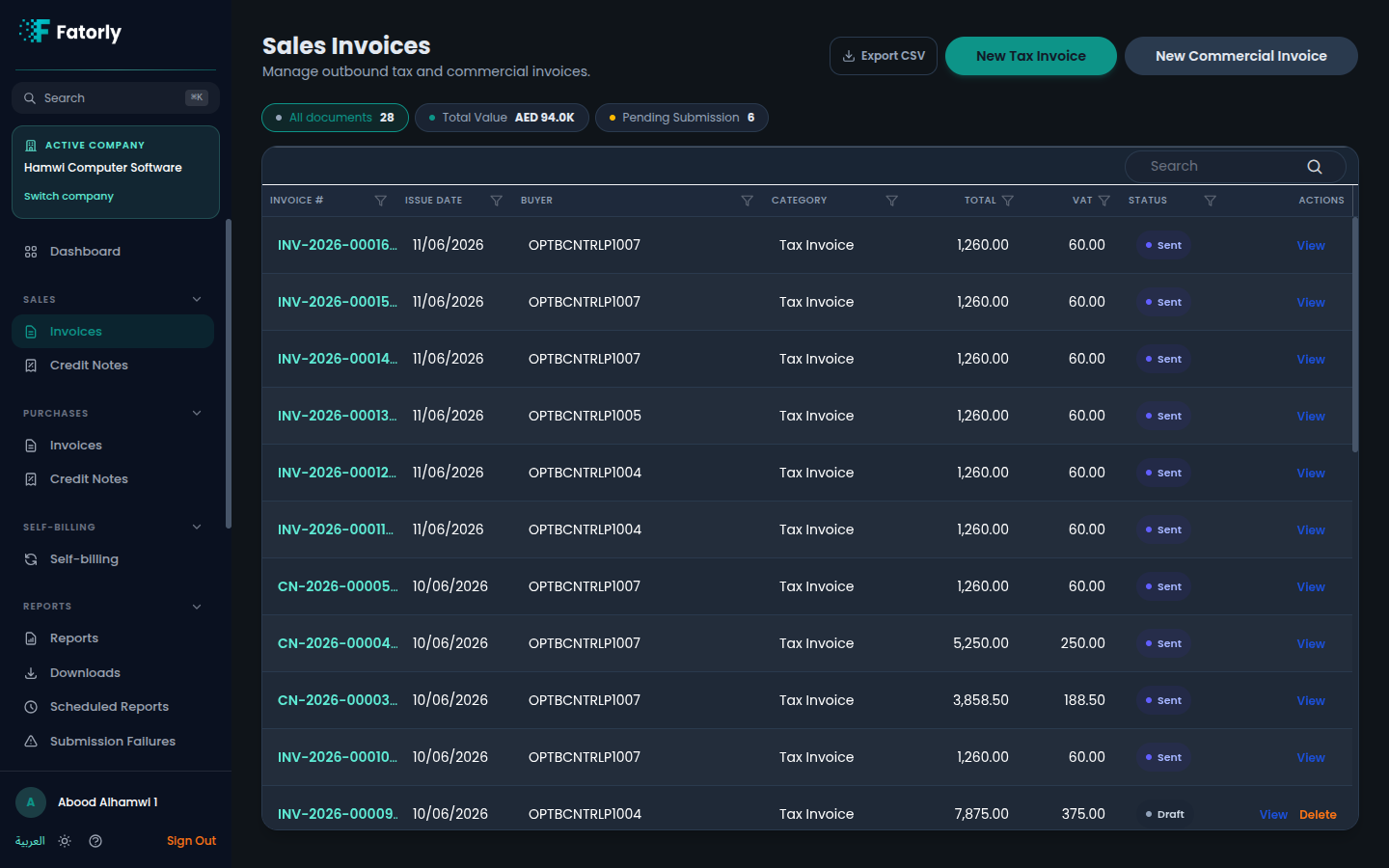
The list
Each row is one document. The grid has these columns:
- Invoice # — the document number from your
number series (for example
INV-2026-00016). Select it to open the document. - Issue Date — the date the invoice was issued.
- Buyer — the customer the invoice was issued to.
- Category — Tax Invoice or Commercial Invoice.
- Total — the total payable in
AED. - VAT — the VAT amount included in the total.
- Status — a badge showing where the document is in its lifecycle, such as Draft or Sent.
- Actions — see Row actions below.
Above the grid, summary chips let you filter and read totals at a glance:
- All documents — shows the full count and is selected by default.
- Total Value — the combined value of the listed invoices in
AED. - Pending Submission — select it to narrow the list to documents that have not yet been submitted.
Use the Search box in the grid toolbar to find a document by number or buyer, and select any column header to sort by it.
Create a new invoice
Two actions in the top-right open the invoice editor:
- New Tax Invoice — a standard VAT tax invoice.
- New Commercial Invoice — a commercial (non-tax) invoice.
To create many invoices at once, choose Import from Excel and follow Import Invoices from Excel.
Tip
Use Export CSV in the top-right to download the current list — handy for reconciliation or sharing with your accountant.
Row actions
The Actions column adapts to the document's status:
- View is always available and opens the invoice view, where you can review the document and submit it.
- Delete appears on Draft documents, which have not yet been submitted.
Note
Once a document has been submitted (status Sent), it can no longer be deleted. To reverse a sent invoice, issue a credit note instead.
Related
- Create or Edit an Invoice — the editor the New buttons open.
- Import Invoices from Excel — create many invoices at once from a workbook.
- View an Invoice — review and submit a document.
- Sales Credit Notes — reverse or correct a sent invoice.
- Customers — the buyers you invoice.